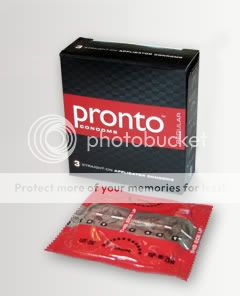
Bagi yang biasa pakai kondom pasti tahu betul susahnya untuk memakai dengan cepat. Dari mulai merobek kemasannya, kemudian menigdentifikasi bagian mana yang dalam/luar sebelum dipasang, plus bahan lubrikannya yang berminyak2 gitu, pokoke ribetlah. Gara2 proses pemekaiannya yang cukup menyiksa tersebut kadang sering membuat 'tegangan' keburu menurun tinggal separuhnya.
Tapi sekarang nggak lagi, sudah ada kondom yang mereknya pronto, yang tehnik pemakaiannya sangat cepat, mudah dan praktis banget. Membukanya cukup dengan mematahkan kemasannya, arah luar/dalam yang jelas dan nggak perlu memegangnya langsung, karena bisa dihandel dari bungkusnya saat pemakiaannya. Speeeeedy wes ewes ewes tinggal tancep... Silakan lihat sendiri video peragaannya
Pendapat terakhir menyimpulkan PPD disebabkan gangguan hormon pada bufas (ibu nifas), yakni terjadinya penurunan kadar insulin yang selanjutnya menurunkan kadar serotonin otak. Serotonin diketahui fungsinya adalah untuk mengatur mood.
Buat ibu2 paska melahirkan ada baiknya melakukan test ini ( test sendiri), karena ternyata banyak kasus PPD terutama yang ringan tidak terdeteksi oleh pasien maupun keluarganya. Gunanya agar bisa diambil langkah dini agar tidak memberat.
Lakukan test ini setelah seminggu paska melahirkan. Yang biasa dipakai adalah : Edinburgh Scale, seperti dibawah ini
1. I have been able to laugh and see the funny side of things: 1. As much as I always could 2. Not quite so much now 3. Definitely not so much now 4. Not at all
2. I have looked forward with enjoyment to things: 1. As much as I ever did 2. Rather less than I used to 3. Definitely less than I used to 4. Hardly at all
*3. I have blamed myself unecessarily went wrong: 1. Yes, most of the time 2. Yes, some of the time 3. Not very often 4. No, never
4. I have been anxious or worried for no good reason: 1. No, not at all 2. Hardly ever 3. Yes, sometimes 4. Yes, very often
*5. I have felt scared or panicky for no good reason: 1. Yes, quite a lot 2. Yes, sometimes 3. No, not much 4. No, not at all
*6. Things have been getting on top of me: 1. Yes, most of the time I haven't been able to cope at all 2. Yes, sometimes I haven't been coping as well as usual 3. No, most of the time I have coped quite well 4. No, I have been coping as well as ever
*7. I have been so unhappy that I have had difficulty sleeping: 1. Yes, most of the time 2. Yes, sometimes 3. Not very often 4. Not at all
*8. I have felt sad or miserable: 1. Yes, most of the time 2. Yes, quite often 3. Not very often 4. No, not at all
*9. I have been so unhappy that I have been crying: 1. Yes, most of the time 2. Yes, quite often 3. Only occasionally 4. No, never
*10. The thought is harming myself has occurred to me: 1. Yes, often 2. Sometimes 3. Hardly ever 4. Never
Penilaian skor:
Untuk pertanyaan nomor 1,2 and 4 (tanpa tanda * asterisk) - jawaban nomor 1 nilainya 0; nomor 2 = 1, 3 = 2 dan 4 nilainya = 3 poin.
Untuk pertanyaan 3, 5-10 (dengan tanda *asterisk) - jawabab pertanyaan nomor 1 nilainya = 3 poin, 2 = 2, 3 = 1 dan jawaban no 4 = 0 poin.
Skor Maximum = 30 points
Kemungkinan depresi jika skor minimal 10, hubungi dokter kamu.
Post ini merupakan reaksi awal atas keluhan Sashy (23 thn) di shoutbox. Berikut adalah kuisioner untuk mendeteksi suatu kelainan sex yang bersifat kompulsif (compulsive sexual behavior= CSB) yang termasuk didalamnya melakukan masturbasi berulang-ulang dan 'nagih'. Akronim yang dipakai CSBST = CSB Screening Test = SAST = Sexual Addict Screening Test. Berikut kuisionernya.
Please check any of the following which apply: I have no concerns about my sexual behavior but am curious how I would score. I have no concerns about my sexual behavior but others are concerned. I am having problems with my sexual behavior but do not consider myself a "sex addict". I know I am a sex addict. I have sought therapy because of my sexual problems.
To complete the test, answer each question by placing a check in the appropriate yes/no column.
Yes
No
1.
Were you sexually abused as a child or adolescent?
Yes
No
2.
Did your parents have trouble with sexual behavior?
Yes
No
3.
Do you often find yourself preoccupied with sexual thoughts?
Yes
No
4.
Do you feel that your sexual behavior is not normal?
Yes
No
5.
Do you ever feel bad about your sexual behavior?
Yes
No
6.
Has your sexual behavior ever created problems for you and your family?
Yes
No
7.
Have you ever sought help for sexual behavior you did not like?
Yes
No
8.
Has anyone been hurt emotionally because of your sexual behavior?
Yes
No
9.
Are any of your sexual activities against the law?
Yes
No
10.
Have you made efforts to quit a type of sexual activity and failed?
Yes
No
11.
Do you hide some of your sexual behaviors from others?
Yes
No
12.
Have you attempted to stop some parts of your sexual activity?
Yes
No
13.
Have you felt degraded by your sexual behaviors?
Yes
No
14.
When you have sex, do you feel depressed afterwards?
Yes
No
15.
Do you feel controlled by your sexual desire?
Yes
No
16.
Have important parts of your life (such as job, family, friends, leisure activities) been neglected because you were spending too much time on sex?
Yes
No
17.
Do you ever think your sexual desire is stronger than you are?
Yes
No
18.
Is sex almost all you think about?
Yes
No
19.
Has sex (or romantic fantasies) been a way for you to escape your problems?
Yes
No
20.
Has sex become the most important thing in your life?
Yes
No
21.
Are you in crisis over sexual matters?
Yes
No
22.
Has the Internet created sexual problems for you?
Yes
No
23.
Do you spend too much time online for sexual purposes?
Yes
No
24.
Have you purchased services online for erotic purposes (sites for dating, pornography, fantasy and friend finder)?
Yes
No
25.
Have you used the Internet to make romantic or erotic connections with people online?
Yes
No
26.
Have people in your life been upset about your sexual activities online?
Yes
No
27.
Have you attempted to stop your online sexual behaviors?
Yes
No
28.
Have you subscribed to or regularly purchased or rented sexually explicit materials (magazines, videos, books or online pornography)?
Yes
No
29.
Have you been sexual with minors?
Yes
No
30.
Have you spent considerable time and money on strip clubs, adult bookstores and movie houses?
Yes
No
31.
Have you engaged prostitutes and escorts to satisfy your sexual needs?
Yes
No
32.
Have you spent considerable time surfing pornography online?
Yes
No
33.
Have you used magazines, videos or online pornography even when there was considerable risk of being caught by family members who would be upset by your behavior?
Yes
No
34.
Have you regularly purchased romantic novels or sexually explicit magazines?
Yes
No
35.
Have stayed in romantic relationships after they became emotionally or physically abusive?
Yes
No
36.
Have you traded sex for money or gifts?
Yes
No
37.
Have you maintained multiple romantic or sexual relationships at the same time?
Yes
No
38.
After sexually acting out, do you sometimes refrain from all sex for a significant period?
Yes
No
39.
Have you regularly engaged in sadomasochistic behavior?
Yes
No
40.
Do you visit sexual bath-houses, sex clubs or adult video/bookstores as part of your regular sexual activity?
Yes
No
41.
Have you engaged in unsafe or "risky" sex even though you knew it could cause you harm?
Yes
No
42.
Have you cruised public restrooms, rest areas or parks looking for sex with strangers?
Yes
No
43.
Do you believe casual or anonymous sex has kept you from having more long-term intimate relationships?
Yes
No
44.
Has your sexual behavior put you at risk for arrest for lewd conduct or public indecency?
Yes
No
45.
Have you been paid for
Selengkapnya untuk bisa menilai klik disini. Setelah diisi, pencet SUBMIT lalu akan keluar grafik SAST, apakah anda termasuk addict atau tidak. Selanjutnya dibagian bawahnya terdapat sedikit keterangan (tulisan tebal) tentang addictnya.
VariZIG™ (Varicella Zoster Immune Globulin (Human) mengandung gamma globulin (IgG) yang berasal dari plasama darah manusia yang mengandung antibodi virus varicella zoster virus (anti-VZV), yang sudah dimurnikan dengan prosese tertentu. VZV merupakan vius yang menyebabkan cacar air (chickenpox).
VariZIG™ diberikan untuk mencegah atau mengurangi infeksi agar tidak menjadi berat dalam hari 4 pertma serangan VZV. Efektifitas tertinggi hanya jika diberikan dalam 4 hari pertama terpajan oleh VZV, setelah lewat 4 hari maka efeknya tidak jelas/tidak pasti.
Keputusan untuk memakai VariZIG pada wanita hamil harus melalaui penilaian yang bersifat indivudual, tidak pukul rata saja. Hal-hal yang perlu diperhatikan adalah kondisi kesehatan pasien secara umum, jenis pajanan virus dan kemungkinan adanya infeksi varicella yang tidak diketahui sebelumnya.
VariZIG tidak boleh diberikan pada pasien:
Yang diketahui memiliki immunitas terhadap VZV yaitu pernah terinfeksi varicella sebelumnya atau pernah mendapatkan vaksinasi varicella.
Pasien dengan IgA yang rendah, karena dikhawatirkan akan menimbulkan reaksi alergi (anafilaktik).
Ada riwayat alergi.
Hipersensi terhadap bahan2 yang terkandung dalam VariZIG.
Millions of peoples in the world have glaucoma. Sadly, over half of the persons with glaucoma do not know they have it, underscoring the aptness of 17th Century poet John Milton’s phrase “the sneak thief of sight” to describe his own experience with glaucoma. But blindness is not inevitable in glaucoma. With early diagnosis and treatment, most patients do not have significant vision loss. A common reaction of patients when they first learn they have glaucoma is to assume they will eventually go blind. The reality is that when glaucoma is diagnosed early and under treatment, patients usually do very well. With treatment, most patients with glaucoma are able to keep their vision and have a normal life. It’s important for patients to continue lifelong treatment and follow their doctor’s directions.
The Anatomy of the Eye and Glaucoma Glaucoma is actually a group of eye diseases that have in common damage to the optic nerve.Located in the back of the eye, the optic nerve is composed of over 1 million cells. Each cell is several inches long and about 1/20,000th of an inch in diameter. The optic nerve can be damaged in glaucoma as a result of elevated intraocular pressure (IOP). Normal IOP ranges from 10 to 21 mm Hg. Increased IOP can compress the optic nerve, causing nerve cells to die little by little. Elevated IOP is the most common cause of glaucoma.
The IOP is increased in glaucoma because of a buildup of fluid inside the eye. This fluid is called aqueous humor. It is a watery fluid produced by the ciliary body, located behind the iris. Aqueous fluid helps keep the cornea and lens healthy. When the fluid leaves the cornea and lens area, it flows through a tiny spongy structure called the trabecular meshwork.
The trabecular meshwork is1/50th of an inch wide and is situated in the angle where the iris and cornea meet. The trabecular meshwork functions as the eye’s drain, allowing the aqueous fluid to drain from the eye and go into the bloodstream. Glaucoma can occur when the correct amount of fluid cannot flow from inside the eye and through the trabecular meshwork.
IOP elevation is not the only cause of glaucoma. In some patients, glaucoma occurs even though the IOP is normal. This form of glaucoma is believed to be related, at least in part, to poor blood flow to the optic nerve. Also, IOP elevation does not always result in glaucoma. Some people can tolerate an elevated pressure for their entire lives without having damage to the optic nerve. Yet some people can have a normal pressure but the optic nerve is sensitive to that pressure. It’s very difficult to pinpoint exactly when glaucoma comes on. Everybody is different.
Risk Factors for Glaucoma Everyone over the age of 45 is at risk of glaucoma, and the risk rises as people age. The strongest risk factor is IOP elevation. Approximately 5 to 10 million Americans have elevated IOP. African-Americans are at increased risk of glaucoma. It is six to eight times more common in African-Americans than in whites.
The risk of glaucoma is also increased in patients who have taken steroid drugs for a long time or have had a previous eye injury. A blow to the eye, a chemical burn or penetrating injury can lead to glaucoma if the trabecular meshwork is damaged by the injury. Glaucoma can develop soon after the injury or a long time after the injury. Anyone who has had eye trauma should have regular eye exams.
Types of Glaucoma The most common type of glaucoma is primary open-angle glaucoma. It affects approximately 1% of all Americans, usually after age 50. Primary open-angle glaucoma is usually accompanied by an IOP of over 22 mm Hg. This form of glaucoma is termed “open-angle glaucoma” because the angle where the cornea and iris meet is of normal size. It causes no symptoms until vision loss has occurred.
Normal-tension glaucoma is another type of open-angle glaucoma. It may account for as many as one third of the cases of primary open-angle glaucoma. With normal-tension glaucoma, the IOP remains in the normal range, but for some reason, the optic nerve is susceptible to damage even when the IOP is normal. This type of glaucoma may stem, at least in part, from inadequate blood flow to the optic nerve. It is diagnosed by the abnormal appearance of the optic nerve and changes in the peripheral vision.
Angle-closure glaucoma is another form of glaucoma. It affects approximately 500,000 persons in the United States. It tends to be inherited, with several members of a family having the disease. Angle-closure glaucoma is most common in persons of Asian descent. The anatomy of the eyes plays a key role in the development of this type of glaucoma. It is called “angle-closure glaucoma” because the angle where the cornea and iris meet is small, interfering with the passage of aqueous fluid between the iris and lens and causing a buildup of fluid and increased IOP. Some patients with angle-closure glaucoma develop acute glaucoma.
The IOP rises suddenly, to 40 to 70 mm Hg, causing intense pain and nausea and vomiting. The eye becomes very red, the cornea swells, and the vision becomes blurred with halos around lights. Another type of open-angle glaucoma is pigmentary glaucoma. An inherited disease, pigmentary glaucoma is more common in men than in women and often develops at a young age, when patients are in their 20s and 30s. With this form of glaucoma, pigment from the back surface of the iris rubs off and is deposited in the trabecular meshwork, causing the meshwork to clog and prevent the flow of aqueous fluid out of the eye.
While not a type of glaucoma, exfoliation syndrome can lead to glaucoma. Exfoliation syndrome is fairly common, occurring in about 10% of people over age 50. However, glaucoma does not always develop. With exfoliation syndrome, a whitish material builds up on the lens. The exfoliation material does not interfere with vision and is only visible with magnification during an eye examination. The material looks like dandruff flakes and can be rubbed off the lens by movement of the iris. The material may end up in the trabecular meshwork, clogging it, preventing aqueous fluid from leaving the eye and leading to IOP elevation and glaucoma. If exfoliation syndrome is present, the risk of developing glaucoma is about six times higher than the risk in persons without the syndrome.
How the Ophthalmologist Decides Glaucoma Is Present Glaucoma is not usually diagnosed on the initial examination, unless it has gone undetected for a number of years in a patient who has not had regular eye examinations. The ophthalmologist may need to examine the eyes over a period of time to document any changes in the eye pressure, peripheral vision and optic nerve.
Elevated IOP by itself is not sufficient for the diagnosis of glaucoma. A patient with IOP elevation by itself is said to have ocular hypertension. Sometimes a patient with IOP elevation alone is considered to be a glaucoma suspect.
A glaucoma suspect is a patient with some of the findings seen in glaucoma but not enough findings to make a definite diagnosis of glaucoma. The patient may have an elevated pressure but totally normal visual field tests. Or the patient may have a normal pressure but an optic nerve that has the appearance of glaucoma. When a doctor tells a patient that glaucoma is suspected, the patient should ask, why is glaucoma suspected? Is it my optic nerve? My visual field? My eye pressure?. Similarly, if a diagnosis of glaucoma is made, patients should ask about their eye pressures, visual fields and the appearance of their optic nerves.
A combination of three tests performed during an eye examination provides information required for the diagnosis of glaucoma. Tonometry measures the IOP. The visual field test assesses the peripheral vision, an important measure of the health of the optic nerve. Ophthalmoscopy (also called funduscopy or fundus examination) lets the ophthalmologist look at the optic nerve to determine whether it is of normal shape and color. The pupil is dilated to obtain a good view of the optic nerve. On visual field testing, the patient looks straight ahead at a dark computer screen. Tiny dots of light are flashed on the screen, one at a time, in various areas of the peripheral vision. The patient indicates each time a flash of light is seen. Visual field testing provides a map of the peripheral vision, documenting any blind spots that may have developed as a result of glaucoma. Visual field testing can show whether glaucoma is stable or getting worse. Other tests may also be performed to evaluate glaucoma.
Treatment and Follow-up of Glaucoma There are a variety of treatment options for glaucoma. Medications are typically the first line of treatment, but if medications don’t work, then surgical treatment is available. There are several basic kinds of eye drops for treating glaucoma. Those that help control glaucoma by decreasing the rate at which aqueous fluid flows into the eye and those that increase the rate it flows out of the eye. Sometimes a combination of eye drops is required to treat glaucoma. In some patients, a drug taken by mouth is needed to help reduce the flow of fluid into the eye.
Laser surgery, called trabeculoplasty, is another intervention for glaucoma. It is performed by using a laser beam to treat the trabecular meshwork, which permits the fluid to drain out of the eye more easily. Trabeculoplasty is about 80% successful at maintaining control of glaucoma at one year and 50% successful at 5 years.
Another surgical procedure is called trabeculectomy. In this procedure, the eye surgeon creates a new drainage channel in the eye to allow the fluid to drain more easily, reducing the pressure in the eye. Whether trabeculoplasty or trabeculectomy is done first depends on the individual patient. There are various factors to consider, such as the patient’s age, race and type of glaucoma.
The most common mistakes patients make after the diagnosis of glaucoma is not using their medicines correctly and not keeping follow-up appointments. Glaucoma is usually controllable but long-term follow-up and vigilance are required to prevent loss of vision. Regular eye examinations are crucial, both for early detection of glaucoma and for control of the disease. With as many as 50% of persons with glaucoma not knowing that they have it, perhaps the biggest challenge is finding ways to make regular eye examinations a part of everyone’s health care.
Nyeri perut pada wanita hamil merupakan salah satu keluhan terbanyak saat melakukan ANC. Sebetulnya tidak semua rasa sakit tersebut merupakan kelainan yang serius. Namun tidak tertutup kemungkinan rasa nyeri tersebut disebabkan oleh suatu kelianan yang serius.
Penyebab nyeri yang nggak serius diantaranya adanya gembung /gas dalam perut sering terjadi saat hamil karena adanya hormon yangmemperlamabat pencernaan dan pembesaran rahim yang menekan usus dan lambung (tergantung usia hamil).
Konstipasi juga merupakan salah satu penyebab nyeri yang paling sering ditemukan. Berupa rasa tidak enak diperut yang disebabkan oleh pengaruh hormon yang memperlambat gerakan usus serta penekanan rahim terhadap rektum. Ligamentum (=yang menahan rahim pada tempatnya) juga dapat menimbulkan nyeri didaerah kiri dan kanan bawah bagian perut. Nyeri ini mulai dirasakan pada trimester 2, timbul akibat peregangan dan penebalan ligamentum tersebut guna mengakomodir pembesaran rahim akibat bertambahnya usia kehamilan.
Nyeri perut juga bisa dirasakan oleh bumil jika merubah posisi secra tiba-tiba seperti bangun dari posisi duduk atau tempat tiudur, berguling ditempat tidur atau saat kelur dari bathtub.
Berikut ini adalah beberapa penyebab nyeri perut yang serius : Hamil tidak pada tempatnya (hamil ektopik): hamil yang menanamkan diri diluar rongga rahim. Lokasi yang tersering adalah saluran telur (tuba). Kelainan ini biasanya terjadi pada kehamilan trimester 1. Hamil di luar rongga rahim ini akanmenmbulkan nyeri hebat akibat adanya perdarahan didalam rongga perut akibat "pecahnya" kehamilan ektopik. Keguguran: gejala pertama keguguran adalah pendarahan, yang kemudian diikuti dengan nyeri perut akibat kontraksi rahim. Nyeri bersifat ritmik. Menjalar dari pinggang kearah bagian atas kemaluan.
Persalinan kurang bulan: nyeri berasal dari kontraksi rahim . Pada persalinan kurang bulan sering diikuti keluarnya darah yang banyak, sehingga sering disalah artikan sebagai perdarahan pra-persalinan akibat plasenta previa (plasenta tidak pada tempatnya).
Solutio Plasenta: adalah lepasnya plasenta sebelum waktunya. Waktu yang tepat bagi plasenta lepas adalah setelah bayi lahir. Solusio terjadi sebelum bayi lahir bisa akibat trauma misalnya diurut, atau karena penyakit ibu misalnya tensi tinggi. Nyeri terjadi akibat darah terkumpul didalam rahim. Preeklampsia: nyeri dirasakan pada perut bagian atas (ulu hati) dan diikuiti oleh sakit kepala serta gangguan pandangan berupa mata kabur. Kelainan pada preeklampsia berupa naiknya tensi yang disertai bengkak terutama pada kaki serta bocornya protein dari ginjal.
Infeksi saluran kencing: Wanita hamil sering mengalami infeksi saluran kemih. Infeksi pada kandung kemih menimbulkan rasa nyeri dan sensasi terbakar saat BAK. Rasa nyeri dirasakan pada perut bagian bawah.
Kram kaki pada ibu hamil (bumil) merupakan keluhan yang sering diungkapkan oleh bumil saat kunjungan antenatal care (ANC). Serangan kram ini sering timbul dimalam hari. Bagi yang pernah mengalami pasti tahu betul gimana rasanya kram (cramp) dan setelah serangannya, nyeri yang timbul bisa menetap sampai saat bangun pagi. Wanita hamil lebih sering mengalami kram, diduga karena kelelahan otot didaerah kaki yang harsu menahan beban berat tubuh yang bertambah. Hal ini diperberat lagi oleh aliran darah dari kaki yang tidak lancar akibat terbendung oleh pembesaran rahim. (Sering juga mengakibatkan pembuluh vena di kaki melebar). Ada pendapat yang mengatakan kram ini terjadi akibat kekurangan kalsium dan kalium serta kelebihan Fosfor, untuk itu nggak ada salahnya mengkonsumsi kalsium dan kalium serta menghindari fosfor (minuman bersoda, snack ringan).
Berikut adalah usaha yang dapat dilakukan guna mengurangi terjadinya kramp: # Hindari berdiri ataupun duduk dengan melipat kaki dalam jangka waktu yg lama. # Lakukan peregangan (stretching) betis dan kaki pada saat siang hari dan sebelum tidur. # Putar2 pergelangan kaki dan goyangkan ibu jari kaki pada saat duduk. # Usahakan melakukan OR jalan tiap hari, minimal 10 menit. # Berbaring dengan posisi miring kiri guna memperlancar aliran darah balik. # Istiahat jika kelelahan dan angkat / tinggikan kaki jika mungkin. # Pakai stoking khusus hamil. # Mandi air hangat untuk merelaksasikan otot kaki sebelum tidur. # Banyak minum air putih. # Makan suplemen hamil yang mengandung magnesium